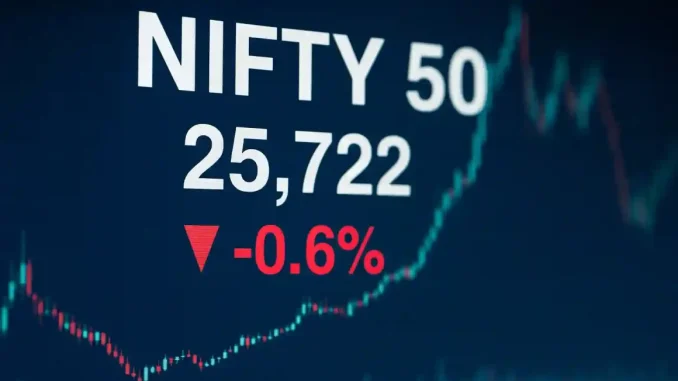
The first echo of daybreak came through the ceiling-to-floor windows of a café in Mumbai’s Bandra-Kurla Complex. A young analyst scrolled through his tablet and noted the figure: Nifty 50 at around 25,722, down by 0.6 percent so far that morning. On the street outside, autos chugged by, coffee steam rose, and the city’s capital-markets engine hummed quietly. Then the question presented itself: what story lurks behind this benchmark’s ebb and flow at this moment?
In many ways, the Nifty 50 acts like the seismograph of India’s market sentiment. It represents the 50 largest and most liquid stocks on the National Stock Exchange of India (NSE), accounting for roughly 55 percent of free-float market capitalization on the exchange. As of early November 2025, it remains in a consolidation phase after a multi-week advance. Analysts expect a trading range somewhere between 25,400 and 26,300 in the near term.
What’s driving the consolidation?
After the Diwali-week surge that pushed the index to a 52-week high of roughly 25,709, the market’s mood appears to have paused for breath. That high was fueled by a combination of returning foreign institutional investor inflows, softer U.S. bond yields, and signs of improved India–U.S. trade relations. Each of these got dialed in on screens, trading desks, and WhatsApp groups.
But once the fireworks died down, the dust settled. Quietly spoken concerns emerged: valuation, margin of safety, and whether the next leg of growth is already priced in. According to one technical setup, the index’s support lies near 25,600 and 25,400, while resistance hovers around 26,100 to 26,300. If it breaks above, the door opens. If it slides below, the risk of a deeper correction looms.
Consider the scenario of a retail investor named Priya. She had bought into a broad-market index fund tracking the Nifty early in 2025 as part of her SIP. Yesterday she messaged her advisor: “When should I add more? Feels like the train may depart.” The answer isn’t simple. The train may be ready, but the tracks are a little uncertain.
The underlying numbers and what they tell us
From a fundamentals perspective, the firms within the Nifty 50 delivered modest progress in FY25: net income rose by about 6.4 percent and EBITDA by 4.5 percent, according to one report. That tells us growth is there but not galloping.
In terms of valuation, the index’s price-to-earnings ratio hovers around 22.7 times and price-to-book around 3.5 times, with a dividend yield near 1.3 percent. In effect, the market is expecting earnings growth to pick up. If that fails, the margin of safety becomes thinner.
Technically, momentum indicators appear mixed. Some data show the Nifty futures (for November) trading at a premium of around 185 points to the cash market, hinting at some optimism. Yet, at the same time, breadth is weak: on one recent session, 41 out of 50 constituents ended in the red.
A broader lens: policy, politics, and culture
It’s not just numbers. The Nifty is a cultural and policy barometer. With India’s push toward greater retail participation in the equity markets, the index reflects not only institutions but the hopes of millions of small investors. For instance, in April 2025, the NSE reported that more than 10 lakh new investors joined the stock market during a month when the Nifty rose about 5 percent.
On the policy front, the Reserve Bank of India’s decisions on rates, the scope of trade negotiations with the U.S., the functioning of public enterprises, and tax policy all ripple through the valuations of large-cap stocks in the index. One example: the financial sector, heavily weighted within the Nifty, responded strongly when banking stocks climbed sharply in past months after a surprise rate cut.
Meanwhile, politically, the remit of large-cap companies is changing. Infrastructure, energy transition, and digital adoption are increasingly reflected in the index weight list. The semi-annual rebalancing in September saw companies such as Max Healthcare Institute and InterGlobe Aviation added to the Nifty 50, while entrenched names were removed. Such changes matter because they can trigger sizeable fund flows into or out of those stocks.
Watch-points moving forward
If I were to create a checklist for investors monitoring the Nifty 50 today, I would highlight:
- Support and resistance. The near-term support levels around 25,600 and 25,400 will signal whether the market is holding ground or slipping. The key resistance at around 26,100 to 26,300 must be breached for fresh upside.
- Earnings growth. A bland earnings season will likely stall the market. If growth accelerates beyond expectations, especially among the Nifty’s heavyweight stocks, the multiple may expand.
- Foreign flows. The return of foreign institutional investors has been a key pillar of the rally. Sustained outflows or dry spells may raise alarm bells.
- Sectoral leadership. The Nifty’s performance often depends on a handful of heavyweights. Watch how banking, technology, and energy sectors behave, as they often dictate the broader trajectory.
- Valuation discipline. At 22 to 23 times earnings, the margin of safety is not wide. Mistakes, macro shocks, or policy missteps may erode value quickly.
So where does that leave us?
The Nifty 50 is at a crossroads. It is neither in a clearly weak slump nor in a free-riding bull run. It is in the quiet middle space of consolidation, which often feels less exciting but carries important implications. For long-term investors, this may be a moment of reflection rather than impulsive buying. For traders, it is about watching tilts and signals.
The market is asking a subtle question: is the next leg of growth already in place, or are we simply looking at an echo of the previous one? The cafés, the analyst desks, and the trading floors are waiting for the answer.
If the Nifty stabilizes around its supports and starts to climb methodically, the air will grow more charged. If instead it cracks below, it could invite a deeper rethink of valuations and strategy. In either case, the index remains not just a number. It reflects the mood, strategy, and pulse of Indian capital.
As one fund manager said on condition of anonymity: “The market’s done the work on sentiment. Now it needs the work on earnings.”
The next few months will reveal whether the Nifty 50 writes a chapter of expansion, or one of waiting.
Leave a Reply